 IT
IT


Milano Smistamento: installed tre first cranes
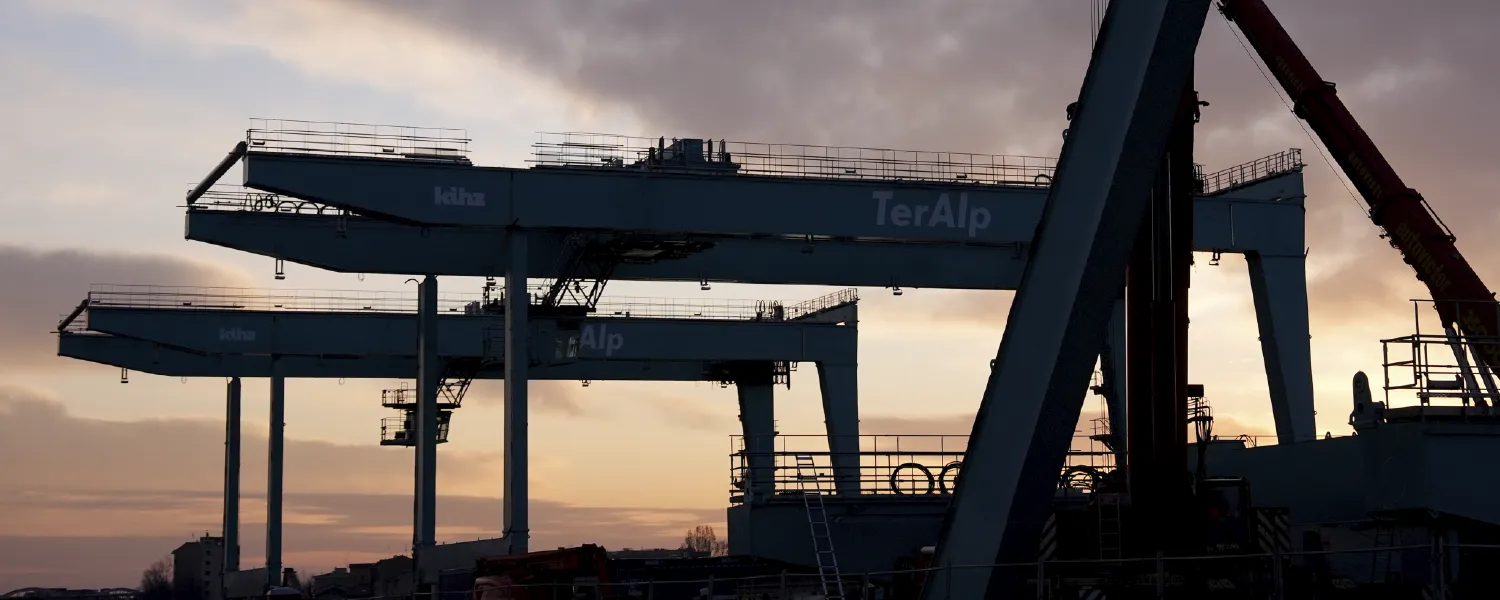
An EUR 120 million investment to strengthen Italy's role in the European logistics corridors. The new Milano Smistamento intermodal terminal gets into full swing, with TerAlp - a company belonging to FS Logistix (FS Group) and subsidiary of Hupac - completing the assembly of the first three electric gantry cranes.
This is a crucial step for one of the major rail intermodality projects in Northern Italy, destined to significantly increase the rail-road interchange capacity and intercept the freight flow growth along the Italy-Switzerland-Northern Europe axis, also through the Gotthard and Monte Ceneri base railway tunnels.
The electric gantry cranes, which can be moved by rail, will be central to load and unload containers, while ensuring high efficiency, safety and environmental sustainability standards. The installation is part of the contract, averaging EUR 31 million, signed in August 2024 with the Austrian company Kuenz for the production, assembly and commissioning of six cranes in total.
In the meantime, construction works on the sub-services and functional technological installations of Module 1 is continuing, along with track renewal interventions, which will progressively define the terminal's operational set-up.
"With the new Milano Smistamento intermodal terminal, we will strengthen FS Group's commitment to major European logistics routes and accelerate a strategic choice, shifting more and more freight from road to rail - said FS Group's CEO and General Manager, Stefano Antonio Donnarumma - This industrial investment combines competitiveness and sustainability, and bolsters the axis with Switzerland and Northern Europe, actively contributing to transport decarbonisation. We are not just building an infrastructure, we are creating a central low-emission logistics network hub, integrated within the territory and capable of driving great economic, environmental and social value.”
“The installation of the first three electric gantry cranes marks a fundamental step forward in the construction of the new Milano Smistamento intermodal terminal, and confirms that we are threading on a solid path - stated Sabrina De Filippis, CEO of FS Logistix - Terminals are the core of intermodality, and transform railway capacity into actual value for companies and for the logistics system. Milano Smistamento is a strategic investment for transport integration and to support international flow growth. It is part of the European vision we are achieving through targeted interventions along the continent's main logistics corridors. Another example of our commitment in this direction is the acquisition of the Antwerp Mainhub terminal, through which can preside over a strategic hub and expand our capacity and connections internationally.”
The new terminal will spread over approximately 240,000 square metres, and will be based on state-of-the-art technology. The infrastructure will consist of 15 tracks, at least 740 meter long - 10 for transshipment operations and 5 supporting tracks - organised in two modules, with three electric gantry cranes each.
“We are very proud of this partnership between the Hupac Group, TerAlp's partner, and FS Logistix - added Bernhard Kunz, TerAlp's Chairman - The new Milano Smistamento terminal platform will be a major opportunity to connect the Italian market and its ports even more efficiently, across the lowland railway axis and the Alpine corridor, and reach the main Northern Europe markets, and as far as Benelux, Germany and Eastern Europe. The resulting capacity boost will also further encourage the shift of freight volumes from road to rail.”
When fully operational, it will handle up to 44 trains per day, with a potential capacity of around 395,000 ITUs/year, thus concretely contributing to the road-to-rail modal shift, and to the sustainable development of freight transport between Italy and Europe.
The project is part of FS Logistix's broader investment plan to build technologically advanced intermodal terminals, capable of responding to the growing demand for international freight transport in an efficient, competitive manner, with a reduced environmental impact.